7 Common Geo Redirect Mistakes (And How to Avoid Them)
Exclusion rules, wrong redirect types, ignoring bots, no fallback, redirect loops, missing hreflang, and forgetting mobile users — the seven mistakes that break geo redirects and how to fix them.
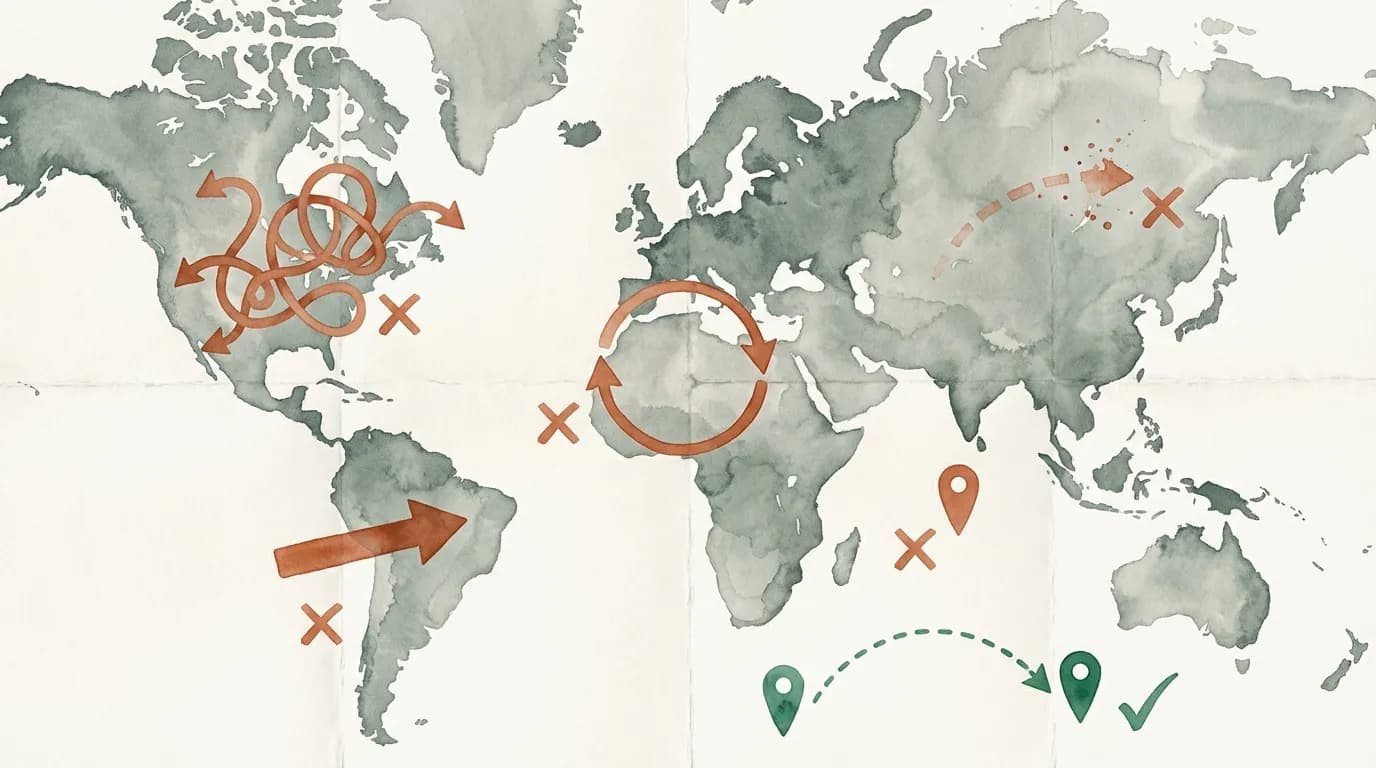
Geo redirects are deceptively simple in concept: detect a visitor's country, send them somewhere else. But the implementation details are where things go wrong. According to Screaming Frog's annual website audit data, redirect misconfiguration is found on 34% of websites, making it one of the most common technical SEO issues. After seeing thousands of geo redirect setups, here are the seven mistakes that cause the most damage — and how to avoid every one of them.
1. Using exclusion rules instead of explicit rules
The most dangerous mistake on this list. An exclusion rule like “redirect everyone NOT in the US” seems logically equivalent to explicitly redirecting each other country. It's not. Googlebot doesn't reliably resolve to the US (or any country) in geolocation databases, so exclusion rules catch it in the redirect — hiding your content from Google.
Fix: Always use explicit rules. “GeoRedirect visitors from France, Germany, Spain” instead of “redirect visitors not from the US.”
2. Using 301 redirects instead of 302s
A 301 tells search engines: “This page has permanently moved. Update your index.” For geo redirects, this is catastrophically wrong. If Googlebot hits your 301 geo redirect even once, it may replace your original URL with the redirect destination in its index.
Fix: All geo redirects should use 302 (temporary) status codes. Google has explicitly confirmed 302 is correct for location-based routing.
3. Not handling search engine bots
If your redirect logic doesn't check for bot user agents, Googlebot and Bingbot are treated like regular visitors. They get redirected based on their IP location (which is unpredictable) and may never see your primary content.
Fix: Implement bot-transparent architecture. Detect known crawler user agents and let them pass through without any geo rules applied.
4. No fallback for unmatched visitors
You set up redirects for US, UK, France, and Germany. A visitor from Brazil arrives. What happens? If you haven't defined a fallback, they either see whatever your default happens to be (which might be wrong) or hit an error.
Fix: Always define a default experience for visitors who don't match any rule. This is usually your English-language or primary market version.
5. Creating redirect loops and chains
Page A redirects French visitors to Page B. Page B redirects non-US visitors back to Page A. The visitor bounces infinitely between the two until the browser gives up. This happens more often than you'd think, especially when different team members configure rules independently.
Fix: Map out all your redirect rules on paper before implementing. Check that no destination page has a rule that could send visitors back to the source. Use a tool that detects potential loops.
6. Ignoring hreflang tags
Geo redirects handle visitor routing. Hreflang tags handle search engine routing. If you have geo redirects but no hreflang tags, Google may show the wrong version of your site in search results for different countries. The visitor then lands on the wrong page and gets redirected — an unnecessary extra hop that hurts performance and user experience.
Fix: Implement hreflang tags on all localized pages. Ensure the hreflang destinations match your geo redirect destinations. Learn more in our geo redirect vs hreflang guide.
7. Not accounting for mobile users and VPNs
Mobile users on cellular networks may resolve to unexpected locations. VPN users appear to be in whichever country their VPN server is in. If you don't provide a way for users to override the redirect, you trap them on the wrong version of your site with no escape.
Fix: Always provide a manual region/language selector. Store the user's preference in a cookie so they aren't redirected again on subsequent visits.
“The single most important rule for geo redirects: explicit targeting, never exclusion. 'Send visitors FROM France to /fr' is safe. 'Send everyone NOT in the US' is a ticking SEO time bomb.”
Avoid all seven automatically
GeoSwap's GeoRedirect is designed to prevent these mistakes by default. It uses 302s, bypasses bots automatically, warns you about exclusion rules, and detects potential redirect loops — all completely free.
Geo redirects are powerful, but the margin for error is slim. Most of these mistakes are invisible until your traffic drops or your customers complain. Use our redirect checker and bot checker to audit your current setup. Get them right from the start, and you'll never have to fix them later.